Showing posts with label Old Testament. Show all posts

17 July 2014

The Commemoration of Ruth (July 16)

IMG_7728

July 16th the Church commemorates Ruth the Moabitess.

1876Merle_Hugues_Ruth_In_The_Fields

IMG_2869

IMG_2864

Snack Ideas: Pretzel "Bundles of wheat", Wheat Thins, Whole Wheat Crackers

IMG_2870

Craft: Baskets for gleaning, idea from HERE.

IMG_2872

To Watch: The Story of Ruth 
To Read: The Story of Ruth and Naomi from the Alice in Bibleland series
Ruth and Naomi Arch Book

To Sing: Our Lutheran Service Book has wonderful hymn for occasions like this,
 #855 For All the Faithful Women:

"For Ruth, who left her homeland
And ventured forth in faith,
Who pledged to serve and worship
Naomi's God till death,
We praise You, God till death,
We praise You, God of Israel,
And pray for hearts set free
To bind ourselves to others
In love and loyalty."

"You promised to preserve Your people and save Your inheritance, using unlikely and unexpected vessels in extending the genealogy that would bring about the birth of Your blessed Son. Give us the loyalty of Ruth and her trust in the one true God, that we, too, might honor You through our submission and respect and be counted among Your chosen People by the Grace of Jesus Christ." Amen. Treasury of Daily Prayer

You can find more about Ruth on this blog HERE.

30 November 2011

Noah (November 29)

 The LORD saw that the wickedness of man was great in the earth, and that every intention of the thoughts of his heart was only evil continually. And the LORD was sorry that he had made man on the earth, and it grieved him to his heart. So the LORD said, "I will blot out man whom I have created from the face of the land, man and animals and creeping things and birds of the heavens, for I am sorry that I have made them." But Noah found favor in the eyes of the LORD.           Genesis 6:5-7


For Christ also suffered once for sins, the righteous for the unrighteous, that he might bring us to God, being put to death in the flesh but made alive in the spirit, 19in which he went and proclaimed to the spirits in prison, 20because they formerly did not obey, when God’s patience waited in the days of Noah,while the ark was being prepared, in which a few, that is, eight persons, were brought safely through water. 21Baptism, which corresponds to this, now saves you, not as a removal of dirt from the body but as an appeal to God for a good conscience, through the resurrection of Jesus Christ, 22who has gone into heaven andis at the right hand of God, with angels, authorities, and powers having been subjected to him.  1 Peter 3:18-22


Just as it was in the days of Noah, so will it be in the days of the Son of Man.  Luke 17:26 (Good Advent verse!)

Activities
A series of paintings telling the story of Noah.
Coloring pages: One, Two,
Lots of Noah's Ark activities and stuff
After reading 1 Peter 3, review the Small Catechism on baptism


-----------------------------

Here's a wonderful Orthodox site with icons of Old Testament people and lots of Easter books and cards. You can get a Noah for next year!(HT Kira)

19 July 2011

Elijah (July 20)


Elijah Taken Up in  a Chariot of Fire Giuseppi Angeli 1740-55
 Other paintings of Elijah can be found here.

From Treasury of Daily Prayer and lcms.org:

The prophet Elijah, whose name means, “My God is Yahweh, the Lord,” prophesied in the northern kingdom of Israel, mostly during the reign of Ahab (874–853 B.C.). Ahab, under the influence of his pagan wife Jezebel, had encouraged the worship of Baal throughout his kingdom, even as Jezebel sought to get rid of the worship of Yahweh. Elijah was called by God to denounce this idolatry and to call the people of Israel back to the worship Yahweh as the only true God (as he did in 1 Kgs 18:20–40). Elijahwas a rugged and imposing figure, living in the wilderness and dressing in a garment of camel's hair and a leather belt (2 Kgs 1:8). He was a prophet mighty in word and deed. Many miracles were done through Elijah, including the raising of the dead (1 Kgs 17:17–24), and the effecting of a long drought in Israel (1 Kgs 17:1). At the end of his ministry, he was taken up into heaven as Elisha, his successor, looked on (2 Kgs 2:11). Later on the prophet Malachi proclaimed that Elijah would return before the coming of the Messiah (Mal 4:5–6), a prophecy that was fulfilled in the prophetic ministry of John the Baptist (Mt 11:14).

Activities 
  • Build an altar with caramel squares (get it?  Mt. Carmel?) and red hots on top to represent God's fire.
  • Make a simple flat bread recipe, remembering how the widow's oil and flour never ran out during the drought (I Kings 17).  Here is an example, although there are many ethnic varieties to choose from if you browse the web!
  • Make a list of how Elijah is a type of Christ.
  • Coloring page

    Ruth (July 16)

    Where you go I will go, and where you lodge I will lodge. Your people shall be my people, and your God my God  Ruth 1:16


    Biography from The Treasury of Daily Prayer and lcms.org:
    Ruth of Moab, the subject of the biblical book that bears her name, is an inspiring example of God's grace. Although she was a Gentile, God made her the great grandmother of King David (Ruth 4:17), and an ancestress of Jesus himself (Mt 1:5). A famine in Israel led Elimelech and Naomi of Bethlehem to emigrate to the neighboring nation of Moab with their two sons. The sons marriend Moabite women, Orpah and Ruth, but after about ten years, Elimelech and his sons died (Ruth 1:1–5). Naomi then decided to return to Bethlehem and urged her daughters-in-law to return to their families. Orpah listened to Naomi's but Ruth refused, replying with the stirring words: “Where you go I will go, and where you lodge I will lodge. Your people shall be my people, and your God my God” (Ruth 1:16). After Ruth arrived in Bethlehem, Boaz, a close relative of Elimelech, agreed to be Ruth's “redeemer” (Ruth 3:7–13; 4:9–12). He took her as his wife, and Ruth gave birth to Obed, the grandfather of David (Ruth 4:13–17), thus preserving the Messianic seed. Ruth's kindness and selfless loyalty toward Naomi, and her faith in Naomi's God, have long endeared her to the faithful and redounded to God's praise for his merciful choice of one so unexpected.
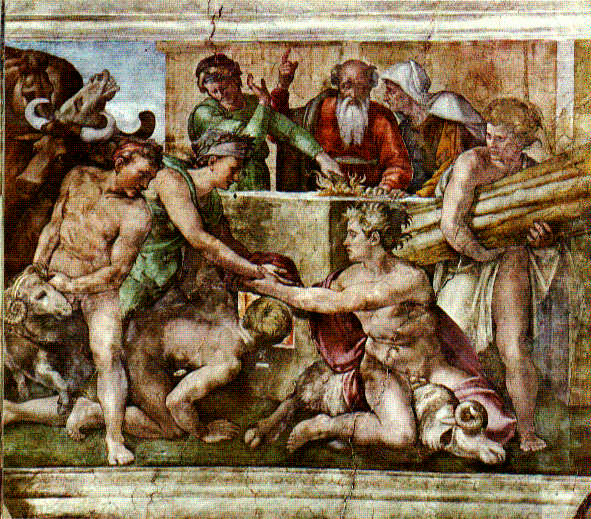
    The last painting above (by Michelangelo) depicts Ruth with her father-in-law, Salmon (husband of Rahab, and one of the spies under Moses and later Joshua).  Some interpreters say this painting connects Moses and the salvation of the Hebrews from slavery, with David (Salmon's descendant), and ultimately with Jesus.  (I love the well-fed and content baby Obed sleeping on Ruth's breast.)

    So Boaz took Ruth, and she became his wife. And he went in to her, and the Lord gave her conception, and she bore a son. 14 Then the women said to Naomi, “Blessed be the Lord, who has not left you this day without a redeemer, and may his name be renowned in Israel! 15 He shall be to you a restorer of life and a nourisher of your old age, for your daughter-in-law who loves you, who is more to you than seven sons, has given birth to him.” 16 Then Naomi took the child and laid him on her lap and became his nurse. 17 And the women of the neighborhood gave him a name, saying, “A son has been born to Naomi.” They named him Obed. He was the father of Jesse, the father of David.   Ruth 4

    "He shall be to you a restorer of life and a nourisher of your old age" can obviously be applied to Christ, the Bread of Life.  But how wonderful that God met Naomi's need for a son,  even while He was preparing his people for their Savior!  Thank God that he provides your needs for this life, even as he prepares you for Eternal Life.


    Activities
    Great gallery of art depicting Ruth (browse bible-art.info/index.htm)

    07 July 2011

    Isaiah (July 6)

    Though he had done so many signs before them, they still did not believe in him, so that the word spoken by the prophet Isaiah might be fulfilled:

    “Lord, who has believed what he heard from us,
    and to whom has the arm of the Lord been revealed?”

    Therefore they could not believe. For again Isaiah said,

    “He has blinded their eyes
    and hardened their heart,
    lest they see with their eyes,
    and understand with their heart, and turn,
    and I would heal them.”

    Isaiah said these things because he saw His glory and spoke of Him.  John 12:38-41


    From lcms.org's Commemoration Biographies:
    Isaiah son of Amoz is considered to be the greatest of the writing prophets and is quoted in the New Testament more than any other Old Testament prophet. His name means “Yahweh, the Lord saves.” Isaiah prophesied to the people of Jerusalem and Judah from about 740 B.C. to 700 B.C. and was a contemporary of the prophets Amos, Hosea, and Micah. Isaiah was a fierce preacher of God's Law, condemning the sin of idolatry. He was also a comforting proclaimer of the Gospel, repeatedly emphasizing God's grace and forgiveness. For this he is sometimes called the “Evangelist of the Old Testament.” No prophet more clearly prophesied about the coming Messiah and his saving kingdom. He foretold the Messiah's miraculous birth (Is 7:14; 9:6), his endless reign (Is 2:1–5; 11:1–16), and his public ministry (Is 61:1–3), but most notably his “Suffering Servant” role and atoning death (52:13—53:12). The apostle John's description of Isaiah, that Isaiah saw Jesus' glory and spoke of him (John 12:41), is an apt summary of Isaiah's prophetic ministry.

    Pastor Walter Snyder has written stanzas to add to By All Your Saints in Warfare (LSB 517), including one about Isaiah (search his site for stanzas appropriate for other commemorations).

    Coloring pages: Touched by a Burning Coal  (disappointing seraphim..), Preaching,  prophesying Christ,

    31 March 2011

    Joseph, Patriarch (March 31)

    Then Joseph could not refrain himself before all them that stood by him; and he cried, Cause every man to go out from me. And there stood no man with him, while Joseph made himself known unto his brethren.And he wept aloud: and the Egyptians and the house of Pharaoh heard.

    And Joseph said unto his brethren, I am Joseph; doth my father yet live? And his brethren could not answer him; for they were troubled at his presence.And Joseph said unto his brethren, Come near to me, I pray you. And they came near. And he said, I am Joseph your brother, whom ye sold into Egypt.

    Now therefore be not grieved, nor angry with yourselves, that ye sold me hither: for God did send me before you to preserve life.  For these two years hath the famine been in the land: and yet there are five years, in the which there shall neither be earing nor harvest.

    And God sent me before you to preserve you a posterity in the earth, and to save your lives by a great deliverance.  So now it was not you that sent me hither, but God: and he hath made me a father to Pharaoh, and lord of all his house, and a ruler throughout all the land of Egypt.    Gen. 45:1-8
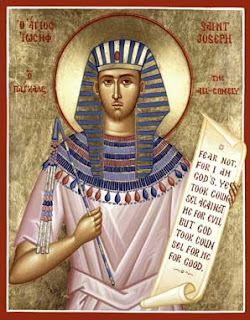

    Modern Icon

    Joseph's Coat. Ford Madox Brown, c. 1860
    Joseph Being Sold into Slavery
    Károly Ferenczy, 1900
    Jacob Receiving the Tunic of Joseph
    Diego Velazquez, c. 1630


    Today I will just read Joseph's story out of Genesis; my kids are already familiar with it from Sunday School and story books.
     
    After reading the story, they will study the paintings and they will decide which part of the story the artist depicted.  One idea I have for commemorations of saints associated with a definite and familiar narrative (Moses, Jonah, Elijah, Noah), is to print out a bunch of paintings with different scenes from their stories (maybe mounting them on card stock so you can reuse them each year), and have early elementary kids put them in chronological order (after reading the story).  I won't do that this year, but maybe in a year or two.

    Since my kids are familiar with Joseph, I decided to try a little Luther commentary on them (not word-for-word, but paraphrase).   I will try out a "game": how is Joseph a lot like Jesus?  So after reading the following commentary (from Chapters 45 - 50, Luther, Martin; "Luther's Works", Vol. 8) to get myself in the right mindset, I came up with a list (and found some more comparisons online):

    On Joseph's sufferings: "Therefore we [Christians] must be troubled and humbled, if not by bloodshed and imprisonment, as the saintly martyrs suffered, at least through spiritual trials, sorrow, grief, and anguish of heart. Otherwise we shall perish in our sins. For the flesh is corrupt, filled with poison, leprous, and has need of a physician to counteract that rottenness by means of cross, martyrdom, sadness, confusion, and disgrace. These, you see, are the medicines with which God purges away sin.

    Holy Scripture is full of such examples. They show that the saints must endure. For when they are not subjected to trials, they forget their spiritual exercises. Then they pray, believe, and praise rather lazily. On the other hand, they cry out, groan, and complain when misfortunes come, and thus they are disciplined and instructed in the Word, as Isaiah says (Is. 28:19): 'Vexation gives understanding.'"

    Joseph as a type of Christ: "Accordingly, I give this warning in order that we may not look at this manifestation of Joseph only in passing but may consider the great affection of the heart by which both Joseph and his brothers were benumbed. I would not know how I should have reacted when he said: 'I am Joseph.' Nor do they know. What will happen, then, when our Lord and Savior JESUS Christ comes, who also disciplines us in various ways in this life and allows us to be troubled, scourged, killed, etc.? What great joy there will be after that sudden and unexpected change, since we previously felt that He was a very harsh tyrant who wanted to destroy everyone in a trice! Then He will say: "I am Joseph; I am your Savior." I cannot explain this revelation of Joseph worthily; but it must be read and pondered often, . . ."

    On the Secular Kingdom and those against the Church:
    "Thus today the emperor, the pope, and the Mohammedans live and remain in this world for no other reason than for the sake of the church, the Word, and the sacraments. When these have been removed, they will perish at once, as Daniel 12:7 testifies: 'When the shattering of the power of the holy people comes to an end, all these things would be accomplished.' But in the meantime states [governments] and the procreation and education of children remain, because the number of the elect has not yet been completed. Many of these have not yet been born. But when the number is completed, then let the pope and the Turk see what will become of them!

    The church alone, however, preserves all things and is a nursery in the world by which the Word and the sacraments are propagated and retained. Proselytes are added to it every day. They hear and embrace the heavenly doctrine. In the meantime the pope, the emperor, and the Turk also rage against us and fight against the pillars that support and preserve them."

    Luther on godly public servants: "Therefore Pharaoh did not receive a private individual, a man whose only concern was domestic or political. No, he received the church of God itself, which he cherishes, nourishes, and defends. This is an outstanding honor and regal dignity. Because of this he was deservedly called a most saintly and godly man, a man honored by God; for he was raised up by God for such an important function in order that he might preserve the church and give it a place, time, and protection, so that it could be gathered, multiplied, and built."

    "Would that today, too, we had more princes like him! For this was an excellent and incomparable virtue in King Pharaoh-a virtue which deserves to be praised by all. And that he was filled with faith and the Holy Spirit is apparent from the fact that he supports the church with such great kindness and without recompense or any greed. For at the present time you could find many who profess the doctrine of the Gospel until they have plundered the parishes, the associations, and the monasteries. There are very few who befriend the teachers and pastors of the churches out of zeal for godliness and from the heart. But if there are such men, they do the right thing by following the example of Pharaoh; but it surely was scrupulous, saintly, and Christian to the highest degree. For Pharaoh has no regard for his private advantage and in supporting the church has no other consideration than piety and reverence for God. He himself seizes nothing. Indeed, he rather offers all his own property and lavishes it on the protection and support of the house of Jacob."

    Jesus and Joseph  
    (I found this list at http://www.reclaimingwalther.org/articles/jmc00294.htm)

    1. Joseph's brothers were bewildered by his visions of his great authority while Christ's disciples never understood the prophecies of His death and resurrection.
     2. Joseph and Jesus were both betrayed and sold; Joseph for 20 pieces of silver and Christ for 30 pieces of silver.
     3. Joseph's coat was dipped in goat's blood; Christ's robe was covered with his own blood.
       4. Joseph was thrown into a pit while Christ was placed in a tomb.
       5. Joseph's father was told Joseph was dead while was Christ killed by the will of both man and God.
       6. While in room by themselves Joseph's eleven brothers discover he is alive. While in a room by themselves Christ's eleven disciples discover has risen from the dead.
       7. Joseph saves his brothers from starvation while Christ saves all His brothers and sisters from sin.
       8. Joseph brings his brothers to repentance while Christ removes sin from us.
       9. Joseph absolves his brothers while Christ pays for our sin.
      10. Joseph has bread for everyone who comes Egypt while Christ is the bread of life for the whole world.
      11. Joseph leads all Egypt to be owned by Pharaoh while Christ has purchased the entire world and places it under God the Father.
      12. God sends Joseph to preserve life while Christ gives us eternal life.
      13. Joseph saves the church in Egypt while Christ saves the Church in heaven.
      14. Joseph announces that God used Him for great deliverance while Christ has delivered us from sin, death, and hell and given us eternal life.
      15. God used Joseph's evil brothers to make Joseph the ruler of Egypt as He used the evil Chief Priests, Scribes, and Pharisees to make Jesus Lord of Lords and King of Kings.

    04 February 2011

    Jacob (February 5)

    39-19-01/62 Victors,Jan. Isaac benissant Jaco...
    Isaac blesses Jacob  Victors, Jan

    Jacob's Dream. de Ribera, Jusepe
    Jacob Fights the Angel Rembrandt

    Jacob Blessing His Children. Rembrandt


    There is so much to say about Jacob: family drama;  sin and deceit; love, heartbreak, sorrow and betrayal.  But the stories in Genesis are about God forever keeping his promises, even to (frankly) horrible people.  And God keeps his promise to Jacob, to Israel, to his Bride.

    I have never really liked Jacob.  David was a sinner, but at least he was manly.  He wasn't a mamma's boy, he waited on God's timing to take his rightful throne, he was loyal and honest (usually).  I believe David when he repents, but I don't trust Jacob when he prays "I am not worthy of the least of all the deeds of steadfast love and all the faithfulness you have shown to your servant..." (Gen 32:10).  I just think, "Yeah, right, you're just scared Esau is going to destroy you. Wimp."

    Until I read an article by a Lutheran pastor arguing Esau was not necessarily damned from eternity (an article I'm still trying to track down), and heard Pr. Nathan Dudley on Issues, Etc., I always had a Reformed understanding of the story of Jacob and Esau (without knowing it).  "Esau I hated" just because he was predestined not to receive the inheritance, was elected to damnation, and "Jacob I loved" just because he was elected to salvation.  I have never held Reformed views on election, but I accepted that interpretation without thinking too much about it, and its full implications.  It was a "hard passage" that seemed to support Reformed theology.

    So back to David vs. Jacob.  Remember when Nathan says to David "You are the man!" (You can read the whole story here)?  Well, God, through his Word in Genesis, is pointing to Jacob and saying to me "You are that man!"  After I just wrinkled my nose and expressed my disgust at Jacob's sliminess.   The Lutheran interpretation of Jacob and Esau as types of the Church and Christ is brilliant (and so obvious once pointed out).  Of course, for all of Jacob's grossness, God still chooses to bless the world through him.

    It helps me to frame the saint or OT character of the day in Christ and his work before I begin our "Saint Time" with the little ones.  "In the Home" includes mom and dad meditating on the commemoration or feast, too, before talking to the little ones (or bigger ones) about who we are celebrating and why.

    Activities
    We will focus on the story of Jacob and Esau and God giving the birthright to Jacob, in spite of Jacob's sin.  We will make lentil soup, color a coloring page, and make some play-doh soup bowls or popsicle stick ladders.

    I found Olney Hymns: In Three Parts by Newton and Cowper, which includes hymns inspired by Genesis passages.  We're not going to try to sing any of these, but here are a few lovely lines:

    "Lo! He saw a ladder rear'd
    Reaching to the heavenly throne,
    At the top the Lord appear'd,
    Spake and claim'd him for his own"

    (As Jacob demands a blessing from the Lord....)
    "No--I must maintain my hold,
    'Tis thy goodness makes me bold;
    I can no denial take,
    When I plead for Jesus' sake."

    The bits on Jacob are found on page 29.

    23 January 2011

    Inter-Food Dialogue

    "Shaved terrier is kosher, right?

    While thinking of ideas for the commemoration of Sarah, I wondered why it was so hard to find traditional activities and meals associated with the Old Testament saints.  After some research, I learned the Old Testament "saint days" were not observed by the Western church until the Reformation.

    This reminded me (there's a point to this post, I promise) of an employer I had in high school.  I worked for a Muslim veterinarian, and he and his family often stayed in an apartment attached to the clinic.  One day his wife brought him some mid-morning food, and he very excitedly explained to me that it was a traditional dish Muslims ate to commemorate Abraham's near-sacrifice of his son (Ishmael, not Isaac, according to Islam).  He offered me a bowl.   "Food offered to idols" popped into my head, and almost simultaneously, "to the pure all things are pure."  I did try some, and it was very good (a sort of runny rice pudding called Seviyan).*

    So I decided to see if I could find a traditional Eastern Orthodox dish inspired by Sarah and Abraham hosting the three guests.  I even tried some Jewish sites.  Did not find anything.

    That is why I made a meal on January 20 inspired by the meal described in Genesis (beef, bread, curds and milk).  I then went through some of the OT patriarchs/prophets/kings/priests commemorated in the Lutheran calendar and thought of meals or dishes based on Bible passages.  Just because no one else has done it before, doesn't mean I can't start my own family traditions.  Here's what we're going to do (I'll post recipes as the days approach):

    Elijah--bread made from oil and flour (poor widow's miracle)
    Sarah--meal prepared for angelic visitors
    Joshua--milk, honey-cakes, grapes (for entering the Promised land)
    Daniel--vegetarian dinner served with water ;)
    David- raisin cakes (like those Abigail brought him, interceding for her husband)
    Jacob-- lentil stew he traded for Esau's birthright
    Jonah-fish and figs
    Peter-- a Gentile dinner ("do not call unclean that which God has made clean"); since Peter shares his feast with Paul, maybe a discussion of the First Council of Jerusalem and the Jewish/Gentile Christian controversies would be relevant.

    Any other ideas?

    *[Don't worry. This blog won't be promoting Muslim holidays or an inter-food alliance, union, or "potbless"]

    Enhanced by Zemanta

    21 January 2011

    Sarah (January 20)

      So Abraham hurried into the tent to Sarah. “Quick,” he said, “get three seahs of the finest flour and knead it and bake some bread.”
      Then he ran to the herd and selected a choice, tender calf and gave it to a servant, who hurried to prepare it.  He then brought some curds and milk and the calf that had been prepared, and set these before them. While they ate, he stood near them under a tree.
      “Where is your wife Sarah?” they asked him.
      “There, in the tent,” he said.
    Then one of them said, “I will surely return to you about this time next year, and Sarah your wife will have a son.”
       Now Sarah was listening at the entrance to the tent, which was behind him.  Abraham and Sarah were already very old, and Sarah was past the age of childbearing.  So Sarah laughed to herself as she thought, “After I am worn out and my lord is old, will I now have this pleasure?”
      Then the LORD said to Abraham, “Why did Sarah laugh and say, ‘Will I really have a child, now that I am old?’  Is anything too hard for the LORD? I will return to you at the appointed time next year, and Sarah will have a son.”
      Sarah was afraid, so she lied and said, “I did not laugh.”
      But he said, “Yes, you did laugh.”                                                  Genesis 18: 6-15

    Hymnody: Lutheran Service Book #855: 1, 3, 4 "For All the Faithful Women"

    Abraham, Sarah, and the Angel. c. 1520. Jan Provost.
    James Tissot - Sarah Hears and Laughs - Art Prints and Posters
    Sarah Hears and Laughs. c. 1896 James Tissot


    Sarah Leading Hagar to Abraham. c. 1637  Matthias Stomer.


    Sarah Presenting Hagar to Abraham. c. 1699. Adriean van der Werff


    Abraham and Sarah. 1956. Marc Chagall


    Interestingly,  most art depicting Sarah shows her handing (a half-dressed) Hagar off to Abraham.

    After reading the Genesis 18 story and showing my children the paintings of Sarah laughing from her tent at God's promise to give her a son in her old age, we talked about how God kept his promise anyway, in spite of Sarah's unbelief.   I emphasized God's faithfulness even when his people are unfaithful. Then we talked about her joy at God giving her Isaac, and how through Isaac, Jesus would eventually be born, bring true joy to his people by saving them from their sins.  My eldest remembered all the stories of the patriarchs and their wives from Sunday School last fall, so she filled her younger brother in on the rest of the story ("then Isaac married Rebekah and had Jacob and Esau.  They were twins!  Two babies!")

    We made a meal like the one Sarah served to the visitors (bread, roast beef, and a yogurt dish).  We also talked a bit about hospitality toward those who visit our home (sharing toys was a big topic). We prayed for women who are unable to have children, that God would give them His blessing and peace (and children, if it pleases Him).

    Summary: As we celebrate and remember the saints before us, for my small  children it helps to focus on particular details or themes, and keep it simple.  Today for us it was laughter (both in disbelief and later in joy), God's faithfulness to his promises, hospitality, and praying for the barren.

    Jewish Children's Books -- Sarah Laughs

    Books: I've read a lot of good reviews of the children's book  Sarah Laughs by Jacqueline Jules.  The book emphasizes Abraham and Sarah's monotheism and holding fast to God's promises. However, as one Amazon reviewer put it, "The neutral language makes this book useful for readers of many faiths." (I believe the author is Jewish.)

    Other activities: You can find coloring pages here and here.  And, in case you're not still recovering from Christmas cookies (we just finished our last frozen sugar cookie last week) or dreading Valentines Day sugar-comas, you can always make star cookie cut-outs, reminiscent of God's promise to Abraham (and Sarah) to make their descendants as the stars in the sky.  You and your child are one of those descendants, born of faith in baptism!


    Enhanced by Zemanta