| Lucas Cranach | ||||||||
 |
| Cranach self-portrait |
Biography of Lucas Cranach taken from Art and the Bible:
Lucas Cranach was the eldest of nine children. His father, Hans Maler, a painter himself, must have given him his first lessons. Lucas adopted the name Cranach when he was already over 30. It refers to his place of birth, the current town Kronach. He moved to Vienna in 1501, and to Wittenberg in 1505, after he had been appointed to the court of Frederic III, elector of Saxony. Experts often see a breach of styles after the move to Wittenberg. His Vienna works were full of expression and very dynamic. After the move, his style became more static.You can view more of Cranach's works at The Athenaeum.
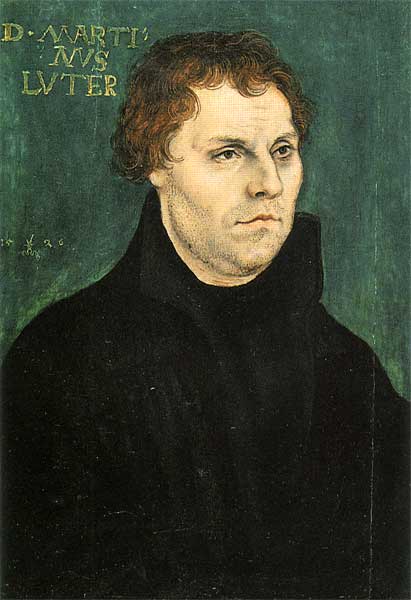
In Wittenberg Cranach met the reformer Martin Luther, whom he portrayed many times. Besides being a painter Cranach also sold medicines and paper, ran a wine pub and printed books. In 1522 he printed the first editions of Luther's German translation of the New Testament. In 1524 Cranach met Albrecht Dürer, the other great German renaissance artist. Dürer made a portrait of Cranach at that occasion.
Lucas Cranach was a member of the Wittenberg city council and was elected as mayor three times. Perhaps it was a talent for politics that enabled him to work for Catholic as well as Protestant clients.
Cranach and his wife Barbara had five children. Together with his sons, Hans and Lucas, Cranach ran a thriving workshop, that produced several thousand paintings, engravings and prints. Often it is not clear exactly who created what. The workshop and his other occupations provided steady revenues to Cranach, making him the wealthiest civilian of Wittenberg.
Cranach remained in the service of Saxonian electors throughout his life. In the service of John Frederic I he moved to Weimar, where he died in 1553.
Albrect Dürer
 |
| Christ as the Man of Sorrows. 1493. |
 |
| Durer Self-portrait |
Biography of Albrecht Dürer from www.Artrepublic.com:
Albrecht Durer worked in many different media including dry point and printmaking. He was an expert in matters of proportion even writing four books on the subject. Despite his scholarly approach to his work he remained a deeply instinctive artist and is regarded as one of the first great draughtsmen of Germany.
(for a more detailed biography and to view all his paintings and sketches, go to http://www.albrecht-durer.org/)
He was born in Nuremberg in 1471. At the age of 15 he was apprenticed to Michael Wolgemut, the book illustrator and painter. He then travelled to Italy where he produced his first notable painting in 1500, a self-portrait. As well as producing woodcuts and engraving she was concerned with tackling many of the key Renaissance questions such as perspective and proportion. In 1505 he moved to Venice where he remained for two years experimenting with technique and produced 'The Feast of the Rose-Garlands'. He specialised in line engravings, which involved cutting into the surface of metal, frequently copper, with a burin, resulting in images very rich in texture. Works such as 'St. Jerome in his Study' (1514) and 'Agony in the Garden'(1515) were produced in this way. He died in 1528.
"What shall I say of the firmness and accuracy of his hand? You could have sworn that what he drew without other means than the brush, pencil, or pen, to the immense astonishment of his beholders, had been drawn with rule and compass. What shall I say of the sympathy which reigned between his hand and his ideas so that often on the spur of the moment he dashed off, or, as painters say, composed sketches of every kind of thing with pencil or pen?" Camerarius, 1528 as quoted by Christopher White in Durer (Phaidon).
Is there documentation that Dürer converted? After reading numerous online biographies, there isn't a clear consensus. Have any of you read a detailed biography (i.e. a book) on him?
---------------------
Blogger isn't working out so well today; I had trouble formatting all the paintings and engravings I wanted to include. Here are some ideas for activities:
*Have grade-school through high school students "copy" their favorite Cranach or Dürer; concentrate on whatever art skills they are working on (so a middle schooler might practice perspective or proportion, a younger child mixing colors, the very talented high schooler using the same media as the artists (this may be a week-long activity)
* Read a biography
Artist of the Reformation: The Story of Albrecht Dürer by Joyce McPhersonAlbrecht Dürer (Art for Children series) by Ernest Lloyd Raboff
* Analyze one painting for its theological content.
*Go to a museum that has a Cranach or Dürer piece (The Chicago Art Institute has many Dürer etchings and Cranach paintings; The Saint Louis Art Museum has two Cranach's and a handful of Durer etchings).
*Talk about the artist's vocation and the modern (romantic) notion of the artist following his genius (in the pagan Roman sense; following his inner deity or "angel"). Cranach and Dürer did not share our romantic ideas of activism, artistic expression as self-expression. What do you think about Cranach painting for Roman Catholics, or Dürer's more humanistic themes? Were they "selling out"?