Showing posts with label Saint Feasts. Show all posts

24 March 2014

St. Joseph Guardian of Jesus (March 19)

2014032909

March 19th is the Feast of St. Joseph, Guardian of Jesus. I'm sure it's just me but Joseph seems to be one of those saints easily overlooked, lurking in the background, in the shadow of Mary and certainly of Jesus.

Joseph is many times painted as looking pretty frail and sad. But in my mind he was a little more manly than that.  We don't know much about him but I believe it's safe to assume he was just like any Daddy.

family-prayer-st-joseph

A Protector

004_mary-et-joseph_theredlist

 Playful

the_grace_of_god_zoom

Tender
(source)

d20d61ce30c2e7825bd229b13a9428a8

Compassionate

ensignlp.nfo-o-1a1

 A Teacher of Scripture

jm_200_NT1.pd-P7.tiff

 A good and honorable father.


IMG_6593

One St. Joseph's Day tradition is to make a "St. Joseph's Altar". As Lutherans we don't pray to saints or pay homage to them so I was uncomfortable making an altar and believing it would bring good fortune to our family. 

I like to think of St. Joseph's Day as the Church's Father's Day and in fact in Italy March 19th (The Feast of St. Joseph) is Father's Day.

So we celebrated the fathers in our family.

IMG_6596

Remembering the Guardian of Jesus by honoring our own fathers and giving thanks for them is a great idea.

Anything you would do for Father's Day would be appropriate for this Feast. I had my children make cards for their father and grandfathers.

IMG_6595

Coloring pages:


IMG_6594

For a snack we made little "Josephs" in his carpenters apron, with a carpenter's square and his staff.

IMG_6600

More cookies, "Joseph's tools", hammers and carpenters squares. 

Other attributes for St. Joseph are: 
Carpenter's square or tools, the infant Jesus, staff with lily blossoms, two turtle doves.

For more ideas for celebrating the Feast of St. Joseph visit:


"We sing our thanks for Joseph,
The guardian of our Lord
Who faithfully taught Jesus
Through craft and deed and word.
Grant wisdom, Lord, and patience
To parents everywhere
Who guide and teach the children
Entrusted to their care."

16 October 2013

The Feast of Saint Hedwig


October 16th is the Feastday of St. Hedwig of Silesia of Poland. I did not know about this saint but as I read more about her I was glad to have come across her. She was a great example of a wife, a mother and a Christian. Hospitable, charitable and devoted to the Christ and His Church in her vocation.


At the age of twelve, Hedwig married Henry I the Bearded. Together they had 7 children.
From Wikipedia
Hedwig and Henry lived very pious lives, and Hedwig had great zeal for religion. Hedwig always helped the poor and donated all her fortune to the Church. According to legend, she went barefoot even in winter, and when she was urged by the Bishop of Wrocław to wear shoes, she carried them in her hands.

The widow moved into the monastery, which was led by her daughter Gertrude, assuming the religious habit of a lay sister, but she did not take vows. She invited numerous German religious people from the Holy Roman Empire into the Silesian lands, as well as German settlers who founded numerous cities, towns and villages in the course of the migration, while cultivating barren parts of Silesia for agriculture.

Activities for the Feast of Saint Hedwig:

Make foot or shoe shaped cookies or bread.

From Catholic Culture - On this feast in Poland, there is a bread called Hedwigsohlen (Shoe Soles of St. Hedwig) that used to be distributed to the poor of Trebnitz on her feast day. The shoe soles remind us of her generosity to the poor, and the fact that she sacrificed her own comfortable shoes in walking to church. Any recipe for a bread that can be formed into a specific shape can be used. Form them into soles of shoes.


Let your children walk around barefoot outside, especially if it's cold! 
Donate to a local food pantry or food drive.  

Prayer for the Feast of Saint Hedwig
O God,
Who didst teach blessed Hedwig
to renounce the pomps of this world,
that, with her whole heart,
she might follow the humble way of Thy cross:
grant that, through example,
we may learn to trample under foot the perishable delights
of this world and by cleaving to Thy cross
overcome whatsoever may be opposed to us.
Who livest and reignest with Thee,
in the unity of the Holy Ghost, world without end.
Amen.

Prayer Source

24 June 2013

Nativity of St. John The Baptist


The Church doesn't typically celebrate the earthly birthdays of its saints but their Heavenly birthdays, the days they died and entered Heaven. There are two exceptions to that, Mary's and John the Baptist's births. As I understand it, the Catholic church teaches that this is because they were born without Original sin. As Lutherans we don't teach or believe that but we still commemorate the birth of St. John the Baptist today.

"And you, child, will be called the prophet of the Most High;
for you will go before the Lord to prepare his ways,
to give knowledge of salvation to his people
in the forgiveness of their sins,
because of the tender mercy of our God,
whereby the sunrise shall visit us from on high
to give light to those who sit in darkness and in the shadow of death,
to guide our feet into the way of peace.” The beautiful words of Zechariah from Luke 1:76-79

Reading: Zechariah and Elizabeth and John's birth from Luke 1

Activities:

Appropriate symbols for teaching about St. John or decorating for this Feast day are: Camel-skin robe, cross, lamb, pouring water from hands or scallop shell for Baptism. 


My children like to watch "Bible shows" so we watched the story of John the Baptist HERE.

On this day we also remember in prayer our sisters who are barren. We pray for their continual comfort and guidance. We can also remember to pray for expectant mothers.


We know that John leaped for joy in Elizabeth's womb, so today is also a good day to emphasize the life of the unborn, teaching our children about the gift and miracle that begins at conception.

Coloring Pages:
One (this is actually Simeon and Anna, but it works!)
Two (Abraham and Sarah, but again, it works.)
Three - A pregnant mama, can easily be turned into Elizabeth.


14 August 2012

St. Mary,Mother of Our Lord (August 15)


Instead of your shame there shall be a double portion;
instead of dishonor they shall rejoice in their lot;
therefore in their land they shall possess a double portion;
they shall have everlasting joy.
For I the LORD love justice;
I hate robbery and wrong;
I will faithfully give them their recompense,
and I will make an everlasting covenant with them.
Their offspring shall be known among the nations,
and their descendants in the midst of the peoples;
all who see them shall acknowledge them,
that they are an offspring the LORD has blessed.
I will greatly rejoice in the LORD;
my soul shall exult in my God,
for he has clothed me with the garments of salvation;
he has covered me with the robe of righteousness,
as a bridegroom decks himself like a priest with a beautiful headdress,
and as a bride adorns herself with her jewels.
For as the earth brings forth its sprouts,
and as a garden causes what is sown in it to sprout up,
so the Lord GOD will cause righteousness and praise
to sprout up before all the nations.
(Isaiah 61:7-11 ESV)


Wonderful readings for this feast!  Here's last year's post, with a lot more art. Send me a link to your favorite painting or depiction of Mary, and I'll post it here.

St. Mary's Day is traditionally associated with herbs, spices, and fruits.  Along those lines, here are some ideas:


Here are Issues, Etc. podcasts on the mother of our Lord:


But when the fullness of time had come, God sent forth his Son, born of woman, born under the law, to redeem those who were under the law, so that we might receive adoption as sons. And because you are sons, God has sent the Spirit of his Son into our hearts, crying, “Abba! Father!” So you are no longer a slave, but a son, and if a son, then an heir through God.        (Galatians 4:4-7 ESV)


10 August 2012

St. Lawrence (August 10)

Today we celebrate St. Lawrence, third century martyr.  Here is my post about him from last year, including a biography.


I learned recently that Lawrence was probably decapitated--the Latin phrase "he suffered (martyred)" was mistaken for "he was roasted" (literally cooked on a gridiron like a side of meat).  I enjoy the humor and flippancy the Church treats death (without crossing into irreverence).  Although probably just a legend, Lawrence is said to have told his persecutors "Turn me over now, I'm done on this side."  My kids thought that was hilarious.

How we will celebrate:
How do you handle the sometimes grisly descriptions of martyrs' deaths?  How do you approach the topic of martyrdom with your children?  


Only Bernini can make roasting on a gridiron look glamorous


13 February 2012

This week in the church year...

Here are links to posts I made last year.

February 13 Priscilla, Aquila, and Apollos
February 15 Philemon and Onesimus
February 16 Philipp Melanchthon
February 18 Martin Luther

Of course, Valentine's Day is this week.  Making all the valentines and decorations takes enough time.  I usually just briefly talk about the man on his day, and tie the color red with martyrdom. What do you do?

20 January 2012

Pastor Appreciation Ideas

This week we celebrate the feasts of both Timothy (24th) and Titus (26th).  As I mentioned last year, it's a good time to thank our pastors for all their dedication, sacrifice, and work toward delivering us God's gifts.

This year, the kids are painting cards and I'll write a thank you note from our family.

Question for all you pastors' wives:  What are some of your favorite gifts parishioners have given you and your family, or maybe just your husband?  I'm thinking something homemade or very inexpensive, but thoughtful.

21 December 2011

St. Thomas (December 21)

“In my Father’s house are many rooms. If it were not so, would I have told you that I go to prepare a place for you? And if I go and prepare a place for you, I will come again and will take you to myself, that where I am you may be also. And you know the way to where I am going.” Thomas was the one who responded, “Lord, we do not know where you are going. How can we know the way?” To this Jesus answered: “I am the way, and the truth, and the life. No one comes to the Father except through me."
John 14:1-6


The Incredulity of St. Thomas  Carravaggio 1602


One reason I like the Church Year is because it keeps us from focusing exclusively on one event or doctrine.  In the middle of setting up nativity scenes and cutting out manger-cookies, hanging star and angel ornaments, here's a feast seemingly far from Christmas.  And yet, Christ was born of woman, under the Law, and Thomas (as witness above) stuck his finger inside that real Flesh.


Check out Pr. McCain's post for more Scripture on and history of St. Thomas.  


Traditions/Activities
"Pie Day" in some parts of the world; prepare and freeze pies for Epiphany (I don't know if this is intented, but it's a nice tie to Thomas realizing and confessing who Christ is after he touched his side)


It is a Charity Day in England.  Prepare food for the poor (or donate to a local pantry).  Whereas on St. Nicholas Day we gave toys and childrens' clothes, today we'll collect food for the poor.


Coloring page.


Any ideas?  I find it interesting that searching for "St. Thomas traditions" shows how sectarian the Roman Catholic church is.  Almost always St. Thomas More or Becket show up.  I think I had to look 3 or 4 pages in to find a Catholic page honoring the Feast of St. Thomas the Apostle.   Even Aquinas is pretty  much ignored.  Writing this blog has revealed who and what holy days are important to contemporary American RC piety.  

06 December 2011

St. Andrew (November 30)

I just finished this post today, but I thought I'd put it up instead of waiting until next year.  How did you celebrate St. Andrew's Day? 
--------------------------------------------------------------------------------------------------------
While walking by the Sea of Galilee, he saw two brothers, Simon (who is called Peter) and Andrew his brother, casting a net into the sea, for they were fishermen. And he said to them, "Follow me, and I will make you fishers of men." Immediately they left their nets and followed him.    Matthew 4:18-20

One of the two who heard John speak and followed Jesus was Andrew, Simon Peter's brother. Hefirst found his own brother Simon and said to him, “We have found the Messiah” (which means Christ). He brought him to Jesus.                      John 1:40-42 
The Calling of Saint Peter and Saint Andrew, James Tissot c.1889

St. Andrew, A fragment of a Florentine fresco, 14th c.

San Andres. Jose de Ribera. 1616

Crocifissione di S. Andrea. Carlo Dolci.  1646.


Hymn:  LSB 586  (Check out The Hymn of the Day on lcms.org), and of course LSB 517.5

Extra-biblical history from Catholic Encyclopedia:

06 November 2011

I haven't given up on this blog yet!

My beautiful excuse: Mary Elizabeth born September 11, born again September 25.

My less-than-beautiful excuse: This is hard.  I had visions four children ago of some sort of elaborate home school unit study based on the Church Year.   Our house will probably be more like this in a few years (with less Mexican and more Greek, but similarly spontaneous and maybe dangerous, and me bemoaning the lack of decorum).

Blessed All Saints' Week!

15 August 2011

St. Mary, Mother of Our Lord (August 15)

Happy St. Mary's Day!  I did not have time this week to put together a proper post, but here are some of my favorite paintings of Mary:


I'm realizing, this first year of creating a curriculum of activities around the Church's Year and Feasts, that sometimes it's OK just to talk about who we are honoring.  We sang the Magnificat, but didn't do any particular crafts or traditional baking or even coloring sheets.  It's nice to honor Mary--and talk about her--outside of the Christmas season.  We talked about death (and how for the Christian, death is really just like sleep), and what a saint is.

***


And a great sign appeared in heaven: A woman clothed with the sun, and the moon under her feet, and on her head a crown of twelve stars. 2 And being with child, she cried travailing in birth: and was in pain to be delivered. 3 And there was seen another sign in heaven. And behold a great red dragon, having seven heads and ten horns and on his heads seven diadems. 4 And his tail drew the third part of the stars of heaven and cast them to the earth. And the dragon stood before the woman who was ready to be delivered: that, when she should be delivered, he might devour her son. 5 And she brought forth a man child, who was to rule all nations with an iron rod. And her son was taken up to God and to his throne. 6 And the woman fled into the wilderness, where she had a place prepared by God, that there they should feed her, a thousand two hundred sixty days.

    7 And there was a great battle in heaven: Michael and his angels fought with the dragon, and the dragon fought, and his angels. 8 And they prevailed not: neither was their place found any more in heaven. 9 And that great dragon was cast out, that old serpent, who is called the devil and Satan, who seduceth the whole world. And he was cast unto the earth: and his angels were thrown down with him. 10 And I heard a loud voice in heaven, saying: Now is come salvation and strength and the kingdom of our God and the power of his Christ: because the accuser of our brethren is cast forth, who accused them before our God day and night. 11 And they overcame him by the blood of the Lamb and by the word of the testimony: and they loved not their lives unto death.

24 June 2011

Nativity of St. John the Baptist (June 24)

Happy "Summer Christmas"!  I'm working on a real post for the Nativity of St. John, but for now, here is a passage  from A Yearbook of Seasons and Celebrations by Joanna Bogle. 

Think of the year as a circle.  It may help to draw one on a piece of paper.  At the top, draw a small Christmas tree.  That reminds us of Christmas, the annual feast that marks the birth of Jesus Christ.  This feast is celebrated around the time of the winter solstice--that is to say, the shortest day of the year.  Long ago our pagan ancestors understood some significance in the shortening and lengthening of the days.  They sough to give some meaning to something that they could--correctly--see as symbolic of death and life, of endings and beginnings, perhaps even of some hint of life beyond the grave.  The ancient Romans--whose religious ideas were in general more refined and coherent than those of the lands they conquered--also had feasts connected to the various seasons of the year. 
Christ was born into the Roman Empire--that same Empire of which Britain was a part.  As the story of his life, death, and resurrection spread across the world--through the trade routes of the Empire--it was natural that a new and Christian significance would be given to the seasons of the year.  At the time of the shortest and darkest day, it was natural to celebrate the birth of Christ,  the "Light of the World."  The Early Church, through much debate and also through practical experience, found itself 'inculturating' itself into the customs and traditions of people everywhere.  It also had its rich Jewish tradition and background, in which dates and seasons were of central importance and in which the timing of the Passover was deeply connected to the great Christian "new Passover"  of Christ, the ultimate Pascal Lamb, sacrificed once and for all so that all of humanity could "pass over" into union with God and a share of his blessing.  The old pagan beliefs represent some sort of hope in a Divinity:  now, in Christ, God himself reaches down t o answer, and to make sense of the longing placed in people's hearts and expressed through pagan religions.
Draw a straight line down from your Christmas tree to the bottom of the circle.  That's Midsummer Day, the summer solstice, the longest day of the year.  In the Church calendar, 24 June--the summer equivalent of 24 December, Christmas Eve--is the 'summer Christmas', the feast of the birthday of John the Baptist.
John the Baptist links the Old and the New Testaments.  [It's] important to understand his prophetic role, as the cousin of Christ who prepared the way for the coming of the Saviour.  He said of Christ, " He must increase and I must decrease": after John the Baptist's birthday, the days get shorter, after Christ's they get longer.
The passage continues, explaining other parts of the church year in the circle illustration.  I highly recommend buying the book, or getting it through interlibrary loan.  There is a certain quaintness and naturalness to the writing and descriptions that is hard to find in Church Year traditions books, which are often self-conscious (or sectarian).  Mrs. Bogle is unashamedly English.  Sometimes the pagan origins of Christian feasts come through in an embarrassingly superstition way; after reading her book, I sympathize with the English Puritans' anti-Church Year dogmas, although I of course ultimately disagree with them.  I hope to find comparable books from other Christian regions (no success as of yet!). 

Some St. John's Day Traditions Bogle records:
  • Having a bonfire and party outside at night, roasting sausages and eating pastries.  St. Elizabeth supposedly lit a fire as a beacon to announce to her neighbors that John had been born.  
  • Many Nativity plays performed outdoors were actually done at Midsummer, not in December (Shakespeare included a donkey and "rustics" on purpose in A Midsummer Night's Dream; his audience would have caught the reference).
We've held a "carol and hymn-sing" party sometime within the 12 days of Christmas.   We've talked about a campfire/picnic/game day in the summer, and St. John's birthday would be a great idea.  Maybe eventually it could turn into a neighborhood block party!!  A summer feast is a great way to welcome into the world the man who would point us to Christ:

"Behold, the Lamb of God, who takes away the sins of the world."


10 June 2011

St. Barnabas (June 11)

Now those who were scattered after the persecution that arose over Stephen traveled as far as Phoenicia, Cyprus, and Antioch, preaching the word to no one but the Jews only.  But some of them were men from Cyprus and Cyrene, who, when they had come to Antioch, spoke to the Hellenists, preaching the Lord Jesus. And the hand of the Lord was with them, and a great number believed and turned to the Lord.Then news of these things came to the ears of the church in Jerusalem, and they sent out Barnabas to go as far as Antioch. When he came and had seen the grace of God, he was glad, and encouraged them all that with purpose of heart they should continue with the Lord.  For he was a good man, full of the Holy Spirit and of faith. And a great many people were added to the Lord. Acts 11:19-24


St. Barnabas being instructed by the"Teacher of the Apostles" (the Church, as represented by Mary)

Martyrdom of Barnabas

A Cyprian Jew, Barnabas, born Joseph, was a fellow missionary with Paul.  He was first to receive Paul after his conversion, and bring him to the apostles (Acts 9:27).  Later, when news of conversions in Antioch reached the church in Jerusalem, Barnabas traveled there to confirm the reports and encourage the new converts, who had been evangelized by Barnabas' fellow countrymen, Cyprian christians.   Realizing the Gentiles were ripe for the Gospel, he convinced Paul to join him, and they labored in Antioch.  Later, along with Barnabas' nephew John Mark, the missionaries traveled to Cyprus and other Gentile cities.  They received much persecution from local Jews.  Barnabas was present at the Council of Jerusalem (Acts 14).  He later returned to Cyprus with John Mark. 

Legend says Barnabas was the first bishop of Milan and converter of St. Clement.  He also is said to have written the Epistle to the Hebrews, although this is probably not true.

From the Catholic Encyclopedia: With the exception of St. Paul and certain of the Twelve, Barnabas appears to have been the most esteemed man of the first Christian generation. St. Luke, breaking his habit of reserve, speaks of him with affection, "for he was a good man, full of the Holy Ghost and of Faith". His title to glory comes not only from his kindliness of heart, his personal sanctity, and his missionary labours, but also from his readiness to lay aside his Jewish prejudices, in this anticipating certain of the Twelve; from his large-hearted welcome of the Gentiles, and from his early perception of Paul's worth, to which the Christian Church is indebted, in large part at least, for its great Apostle. His tenderness towards John Mark seems to have had its reward in the valuable services later rendered by him to the Church.

Coloring pages: Barnabas' gift to the church

Activities: Make some Cyprian food, read about Christians today in the places Paul and Barnabas traveled,

And here are some St. Barnabas Day sermons:
Pr. Weedon
Pr. Beane

(If you have favorite sermons from Feast Days from your Pastor--or any Lutheran pastor--email me a copy and I'll post it on the proper day.  For those of us whose churches don't observe feasts which fall during the week--or who are unable to attend the services--a sermon accompanying the lectionary is useful! Thanks!)

31 March 2011

Joseph, Patriarch (March 31)

Then Joseph could not refrain himself before all them that stood by him; and he cried, Cause every man to go out from me. And there stood no man with him, while Joseph made himself known unto his brethren.And he wept aloud: and the Egyptians and the house of Pharaoh heard.

And Joseph said unto his brethren, I am Joseph; doth my father yet live? And his brethren could not answer him; for they were troubled at his presence.And Joseph said unto his brethren, Come near to me, I pray you. And they came near. And he said, I am Joseph your brother, whom ye sold into Egypt.

Now therefore be not grieved, nor angry with yourselves, that ye sold me hither: for God did send me before you to preserve life.  For these two years hath the famine been in the land: and yet there are five years, in the which there shall neither be earing nor harvest.

And God sent me before you to preserve you a posterity in the earth, and to save your lives by a great deliverance.  So now it was not you that sent me hither, but God: and he hath made me a father to Pharaoh, and lord of all his house, and a ruler throughout all the land of Egypt.    Gen. 45:1-8
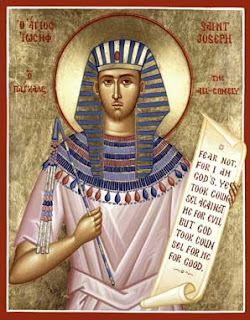

Modern Icon

Joseph's Coat. Ford Madox Brown, c. 1860
Joseph Being Sold into Slavery
Károly Ferenczy, 1900
Jacob Receiving the Tunic of Joseph
Diego Velazquez, c. 1630


Today I will just read Joseph's story out of Genesis; my kids are already familiar with it from Sunday School and story books.
 
After reading the story, they will study the paintings and they will decide which part of the story the artist depicted.  One idea I have for commemorations of saints associated with a definite and familiar narrative (Moses, Jonah, Elijah, Noah), is to print out a bunch of paintings with different scenes from their stories (maybe mounting them on card stock so you can reuse them each year), and have early elementary kids put them in chronological order (after reading the story).  I won't do that this year, but maybe in a year or two.

Since my kids are familiar with Joseph, I decided to try a little Luther commentary on them (not word-for-word, but paraphrase).   I will try out a "game": how is Joseph a lot like Jesus?  So after reading the following commentary (from Chapters 45 - 50, Luther, Martin; "Luther's Works", Vol. 8) to get myself in the right mindset, I came up with a list (and found some more comparisons online):

On Joseph's sufferings: "Therefore we [Christians] must be troubled and humbled, if not by bloodshed and imprisonment, as the saintly martyrs suffered, at least through spiritual trials, sorrow, grief, and anguish of heart. Otherwise we shall perish in our sins. For the flesh is corrupt, filled with poison, leprous, and has need of a physician to counteract that rottenness by means of cross, martyrdom, sadness, confusion, and disgrace. These, you see, are the medicines with which God purges away sin.

Holy Scripture is full of such examples. They show that the saints must endure. For when they are not subjected to trials, they forget their spiritual exercises. Then they pray, believe, and praise rather lazily. On the other hand, they cry out, groan, and complain when misfortunes come, and thus they are disciplined and instructed in the Word, as Isaiah says (Is. 28:19): 'Vexation gives understanding.'"

Joseph as a type of Christ: "Accordingly, I give this warning in order that we may not look at this manifestation of Joseph only in passing but may consider the great affection of the heart by which both Joseph and his brothers were benumbed. I would not know how I should have reacted when he said: 'I am Joseph.' Nor do they know. What will happen, then, when our Lord and Savior JESUS Christ comes, who also disciplines us in various ways in this life and allows us to be troubled, scourged, killed, etc.? What great joy there will be after that sudden and unexpected change, since we previously felt that He was a very harsh tyrant who wanted to destroy everyone in a trice! Then He will say: "I am Joseph; I am your Savior." I cannot explain this revelation of Joseph worthily; but it must be read and pondered often, . . ."

On the Secular Kingdom and those against the Church:
"Thus today the emperor, the pope, and the Mohammedans live and remain in this world for no other reason than for the sake of the church, the Word, and the sacraments. When these have been removed, they will perish at once, as Daniel 12:7 testifies: 'When the shattering of the power of the holy people comes to an end, all these things would be accomplished.' But in the meantime states [governments] and the procreation and education of children remain, because the number of the elect has not yet been completed. Many of these have not yet been born. But when the number is completed, then let the pope and the Turk see what will become of them!

The church alone, however, preserves all things and is a nursery in the world by which the Word and the sacraments are propagated and retained. Proselytes are added to it every day. They hear and embrace the heavenly doctrine. In the meantime the pope, the emperor, and the Turk also rage against us and fight against the pillars that support and preserve them."

Luther on godly public servants: "Therefore Pharaoh did not receive a private individual, a man whose only concern was domestic or political. No, he received the church of God itself, which he cherishes, nourishes, and defends. This is an outstanding honor and regal dignity. Because of this he was deservedly called a most saintly and godly man, a man honored by God; for he was raised up by God for such an important function in order that he might preserve the church and give it a place, time, and protection, so that it could be gathered, multiplied, and built."

"Would that today, too, we had more princes like him! For this was an excellent and incomparable virtue in King Pharaoh-a virtue which deserves to be praised by all. And that he was filled with faith and the Holy Spirit is apparent from the fact that he supports the church with such great kindness and without recompense or any greed. For at the present time you could find many who profess the doctrine of the Gospel until they have plundered the parishes, the associations, and the monasteries. There are very few who befriend the teachers and pastors of the churches out of zeal for godliness and from the heart. But if there are such men, they do the right thing by following the example of Pharaoh; but it surely was scrupulous, saintly, and Christian to the highest degree. For Pharaoh has no regard for his private advantage and in supporting the church has no other consideration than piety and reverence for God. He himself seizes nothing. Indeed, he rather offers all his own property and lavishes it on the protection and support of the house of Jacob."

Jesus and Joseph  
(I found this list at http://www.reclaimingwalther.org/articles/jmc00294.htm)

1. Joseph's brothers were bewildered by his visions of his great authority while Christ's disciples never understood the prophecies of His death and resurrection.
 2. Joseph and Jesus were both betrayed and sold; Joseph for 20 pieces of silver and Christ for 30 pieces of silver.
 3. Joseph's coat was dipped in goat's blood; Christ's robe was covered with his own blood.
   4. Joseph was thrown into a pit while Christ was placed in a tomb.
   5. Joseph's father was told Joseph was dead while was Christ killed by the will of both man and God.
   6. While in room by themselves Joseph's eleven brothers discover he is alive. While in a room by themselves Christ's eleven disciples discover has risen from the dead.
   7. Joseph saves his brothers from starvation while Christ saves all His brothers and sisters from sin.
   8. Joseph brings his brothers to repentance while Christ removes sin from us.
   9. Joseph absolves his brothers while Christ pays for our sin.
  10. Joseph has bread for everyone who comes Egypt while Christ is the bread of life for the whole world.
  11. Joseph leads all Egypt to be owned by Pharaoh while Christ has purchased the entire world and places it under God the Father.
  12. God sends Joseph to preserve life while Christ gives us eternal life.
  13. Joseph saves the church in Egypt while Christ saves the Church in heaven.
  14. Joseph announces that God used Him for great deliverance while Christ has delivered us from sin, death, and hell and given us eternal life.
  15. God used Joseph's evil brothers to make Joseph the ruler of Egypt as He used the evil Chief Priests, Scribes, and Pharisees to make Jesus Lord of Lords and King of Kings.

18 March 2011

St. Joseph, Guardian (March 19)

And her husband Joseph, being a just man and unwilling to put her to shame, resolved to divorce her quietly. But as he considered these things, behold, an angel of the Lord appeared to him in a dream, saying, "Joseph, son of David, do not fear to take Mary as your wife, for that which is conceived in her is from the Holy Spirit. She will bear a son, and you shall call his name Jesus, for he will save his people from their sins."  All this took place to fulfill what the Lord had spoken by the prophet:  "Behold, the virgin shall conceive and bear a son, and they shall call his name Immanuel"  (which means, God with us). When Joseph woke from sleep, he did as the angel of the Lord commanded him: he took his wife, but knew her not until she had given birth to a son. And he called his name Jesus.    Matthew 1:19-24

Joseph's Dream, 1640.  Georges de La Tour.
An Angel Instructing Joseph to Flee. Illustration from Luther's Church Postils*

St. Joseph the Carpenter. c.1635. Georges de La Tour.

St. Joseph. 1620. Garrit van Honthorst.

Dream of Joseph. Daniele Crespi.

The Death of St. Joseph. 1712. Giuseppe Maria Crespi.
*Courtesy of the Digital Image Archive, Pitts Theology Library, Candler School of Theology, Emory University.  Check out www.pitts.emory.edu/dia/ for more awesome illustrations.  (Thanks,Kira!)


Today we celebrate St. Joseph, the guardian of Jesus.  Joseph was Jesus' adoptive, or earthly father, and probably died before Jesus began his ministry.  We hear of Joseph in the Christmas stories in the Gospels, and when Luke tells us about the family's visit to the Temple.  We know he was a "just man" (observant of the law) and "unwilling to put [Mary] to shame" (merciful and kind). He was a carpenter, or architect (perhaps even a mason, according to some scholars).  Joseph protected Mary and Jesus, fleeing to Egypt when Herod sought to kill Jesus.  

What honor God bestowed on Joseph by appointing him guardian and earthly father of his Son!   What honor God bestows on us parents--especially fathers--by entrusting to us his Baptized sons and daughters.  One of the best wedding gifts my husband and I received was a letter from a dear (married) friend explaining that any children resulting from our union are God's.  How easy it is to think of our children as "ours," and to be possessive in a envious way, claiming every success and despairing at ever failure.  Perhaps Mary and Joseph were reminded--or had to remind themselves--all the time that Jesus was not "theirs," but God's (indeed God Himself).  Jesus certainly reminded them: "Did you not know I would be about my father's business?" and "Who is my mother? Who are my brothers?" 

Some thoughts about Joseph for kids: 
* Joseph was known as a carpenter, a builder.  He took care of his family, and fulfilled his vocation.  Maybe at times he felt inadequate or too lowly to instruct the Son of God, but God did not. We should not despise our callings, but joyfully and diligently perform our work and roles.

* Joseph protected Mary and the young Jesus, providing for them, and keeping them from harm.  We just started saying "girls first!" to our 2-year-old son (getting in line to wash hands, etc.)  Joseph's example is a good one of the man's protective role toward women and children.  Our little societal practices (holding the door, giving a woman the last seat, ladies first) just reflect the larger practice of men protecting and acting gently--being a gentleman--toward the weaker sex.

* Joseph does not seek his own recognition.  Ok, we actually don't know if this is true, but notice how small a part he plays in the Gospels, and how he is always in the background in Nativity scenes (often without a halo!). Yet Mary could not have raised Jesus alone.

Fun Activities and Traditions:


* If everyone is Irish on St. Patrick's Day, everyone is Italian on St. Joseph's Day.  And instead of green you wear red!
* Make zeppoles (or find your nearest Italian bakery to buy some!)
* Have a "fasting feast" with fancy vegetarian dishes and desserts (fava bean dishes are traditional in Italy).
* The Polish pray the Litany on St. Joseph's Day.

I try to tie feast days and the seasons together, especially for my young kids (toddlers are like the Medievals--they love to categorize!)  Notice how Lenten practices are used to celebrate St. Joseph (vegetarian feasting and praying the Litany).  Most of the Scripture passages about St. Joseph are from the Christmas account, and in a few days we will celebrate the Annunciation!  A mini-Christmas in Lent! I love it!  Those who say liturgical calendars focus on one event at the expense of another clearly have never spent a year with the Church.  Christmas, Easter, "Church-time" as my kids call Trinity, are all interconnected and constantly overlapping,  just as we experience the whole salvation drama every Sunday in the Divine Service.